Consumer Insights
Uncover trends and behaviors shaping consumer choices today
Procurement Insights
Optimize your sourcing strategy with key market data
Industry Stats
Stay ahead with the latest trends and market analysis.
The Australia bariatric surgery market covers the surgical and endoscopic weight-loss procedures performed on adults with severe obesity, including sleeve gastrectomy, gastric bypass, revision operations and balloon-based interventions, together with the hospital, surgeon, anaesthetic and device spend attached to them. Most operations are performed laparoscopically in private hospitals, and the surgeon, hospital and prosthesis costs are funded through Medicare, private health insurance or the patient.
In 2025, the market is valued at AUD 295.00 million in 2025 and is forecast to grow at a (CAGR) of 2.40%, reaching AUD 373.96 million by 2035. Growth is supported by a rising obesity burden, with the AIHW reporting in June 2026 that 32.8% of adults were obese, and by gradual adoption of robotic platforms, set against competition from subsidised weight-loss medicines.
Compound Annual Growth Rate
2.4%
Value in AUD million
2026-2035
The Australia bariatric surgery market is being reshaped rather than displaced by weight-loss medicines. Procedure volumes face pressure from injectable therapies, yet severe obesity is widening, private hospital ownership is changing hands and device makers are bringing new staplers, robots and non-surgical options to Australian surgeons.
Three forces are shaping demand: a large and growing pool of eligible patients, with 13.0% of adults severely obese; a narrow public subsidy for semaglutide that leaves most people paying privately for medicines; and a concentrated private hospital sector, where Healthscope's restructuring is moving 25 hospitals to new owners.
In January 2026 Health Minister Mark Butler committed to listing Wegovy on the PBS for a narrow cardiovascular group, and in April 2026 Eli Lilly declined the government's price terms for Mounjaro in type 2 diabetes. In September 2026 a Calvary-led consortium agreed to buy Healthscope's remaining hospitals.
The market is moving from a sleeve-dominated, volume-led model towards a more selective mix of bypass, revision and technology-assisted procedures delivered to patients with higher disease burden. Sleeve gastrectomy leads in value, while one-anastomosis gastric bypass and endoscopic options advance fastest as surgeons and patients look for durable weight loss alongside medicines. Laparoscopic surgery remains the standard approach, and robotic assistance gains share as private hospitals invest in platforms. Private health insurance carries most of the cost, with self-funded patients growing as packages and finance options spread. New South Wales remains the largest region, and Queensland grows quickest on population growth and new private capacity. Registry funding, ownership change among hospital groups and cautious public subsidy of medicines point to a durable rebalancing of care pathways rather than a short cycle.
| Metric | Value |
| Market Size 2025 | AUD 295.00 million |
| Projected Market Size 2035 | AUD 373.96 million |
| CAGR 2026 to 2035 | 2.40% |
| Fastest-Growing Procedure Type | One-Anastomosis Gastric Bypass: 4.1% CAGR |
| Fastest-Growing Surgical Approach | Robotic-Assisted Surgery: 5.6% CAGR |
| Largest Revenue Segment 2025 | Sleeve Gastrectomy |
| Dominant Region | New South Wales |
| Highest CAGR by Region | Queensland: 3.1% |
| Adults with severe obesity, AIHW June 2026 | 13.0% |
Rising Disease Burden Anchors Long-Term Demand
Revenue is on course to expand by about 27% across the decade, from USD 295.00 million in 2025 to USD 373.96 million in 2035 at a 2.4% CAGR. The AIHW reported in June 2026 that 67.1% of adults were overweight or obese, and the bulk of treatment for severe disease remains surgical.
Bypass and Robotics Lead Growth
Sleeve Gastrectomy holds the largest share, but One-Anastomosis Gastric Bypass grows at an estimated 4.1% CAGR and Robotic-Assisted Surgery at an estimated 5.6% CAGR through 2035. Johnson & Johnson MedTech showed its ETHICON 4000 stapler to bariatric surgeons in June 2025, and the Registry reported robotic outcomes work in December 2025.
Medicine Subsidy Remains Narrow
The Pharmaceutical Benefits Advisory Committee recommended Wegovy in November 2025, yet access was described as slow and managed, so most patients still pay privately for medicines or consider surgery.
| Report Summary | Unit | Value |
| Base Year | AUD million | 2025 |
| Historical Period | AUD million | 2019 to 2025 |
| Forecast Period | AUD million | 2026 to 2035 |
| Market Size 2025 | AUD million | 295.00 |
| Market Size 2035 | AUD million | 373.96 |
| CAGR 2026 to 2035 | Percentage | 2.40 % |
| CAGR by Procedure Type: One-Anastomosis Gastric Bypass | Percentage | 4.1 % |
| CAGR by Surgical Approach: Robotic-Assisted Surgery | Percentage | 5.6 % |
| CAGR by Funding Source: Self-Funded and Out-of-Pocket | Percentage | 3.3 % |
| CAGR by Region: Queensland | Percentage | 3.1 % |
| Adults with Obesity, AIHW June 2026 | Percentage | 32.8 |
| Adults Overweight or Obese, AIHW June 2026 | Percentage | 67.1 |
| Market Share by Region 2025 | New South Wales | Dominant Share |
Surgery remains the durable option for severe obesity. Sleeve procedures lead, bypass and robotic techniques grow fastest, and New South Wales leads while Queensland grows quickest.
The Australia bariatric surgery market is being reshaped by private hospital ownership change, medicine subsidy decisions, a rising national obesity burden and new technology for surgeons.
September 2026 - Calvary-Led Consortium Agrees to Buy Healthscope's Remaining Hospitals
June 2026 - AIHW Reports 32.8% of Adults Obese and 13.0% Severely Obese
April 2026 - Eli Lilly Declines Government Price Terms for Mounjaro in Type 2 Diabetes
January 2026 - Health Minister Commits to Wegovy PBS Listing for Cardiovascular Patients
Hospital ownership change, narrow medicine subsidies and a widening national obesity burden are the main structural forces, while medicine pricing decisions remain the main risk to surgical volume.
Recent developments, presented from the most recent, show registry funding, a new non-surgical balloon, private hospital acquisition and new stapling technology for bariatric surgeons.
June 2026 - Bariatric Surgery Registry Secures Two Years of Government Funding
February 2026 - Allurion Wins FDA Decision for Swallowable Gastric Balloon System
February 2026 - Ramsay Health Care Agrees to Acquire National Capital Private Hospital
December 2025 - Registry Reports 20 New Surgeons and Early Robotic Bariatric Outcomes
Registry funding, hospital acquisitions and new device approvals show suppliers and hospital operators positioning for a more selective, technology-assisted surgical market through the forecast period.
The Expert Market Research’s report on the Australia Bariatric Surgery Market offers a detailed analysis of the market based on the following segments.
Market Breakup by Procedure Type
Sleeve Gastrectomy leads on value, in our estimate, because registry data show roughly four in five primary operations are sleeves, and it grows at an estimated 1.9% CAGR through 2035 as medicines compete for new patients. Roux-en-Y Gastric Bypass grows at 2.5%, favoured for reflux and diabetes. One-Anastomosis Gastric Bypass grows fastest at an estimated 4.1%, as surgeons adopt a shorter operation. Revision and Other Procedures, including balloons and endoscopic options such as Allurion's capsule decided by the FDA in February 2026, grow at 2.8%.
Market Breakup by Surgical Approach
Laparoscopic Surgery leads, in our estimate, as most operations rely on staplers such as Johnson & Johnson MedTech's ETHICON 4000, shown to bariatric surgeons in June 2025. Robotic-Assisted Surgery grows fastest at an estimated 5.6% CAGR through 2035, backed by the Registry's December 2025 listing of early Australian robotic outcomes and Medtronic's Hugo platform, which gained FDA clearance in December 2025. Endoscopic and Non-Surgical Interventions grow at 3.8%, while Open and Other Approaches decline slightly at 0.4% and remain limited to complex revisions.
Market Breakup by Funding Source
Private Health Insurance leads, in our estimate, because registry data show about 95% of primary operations are privately funded and insurers contract with Healthscope, Ramsay and Calvary hospitals, whose ownership changed through 2026. Self-Funded and Out-of-Pocket grows fastest at an estimated 3.3% CAGR through 2035 as patients without cover or with exclusions pay directly, and as medicine costs reach up to $645 a month according to newsGP in April 2026. Public Hospital and Government Funding grows at 2.0%, held back by waiting lists and limited public theatre capacity.
Market Breakup by Region
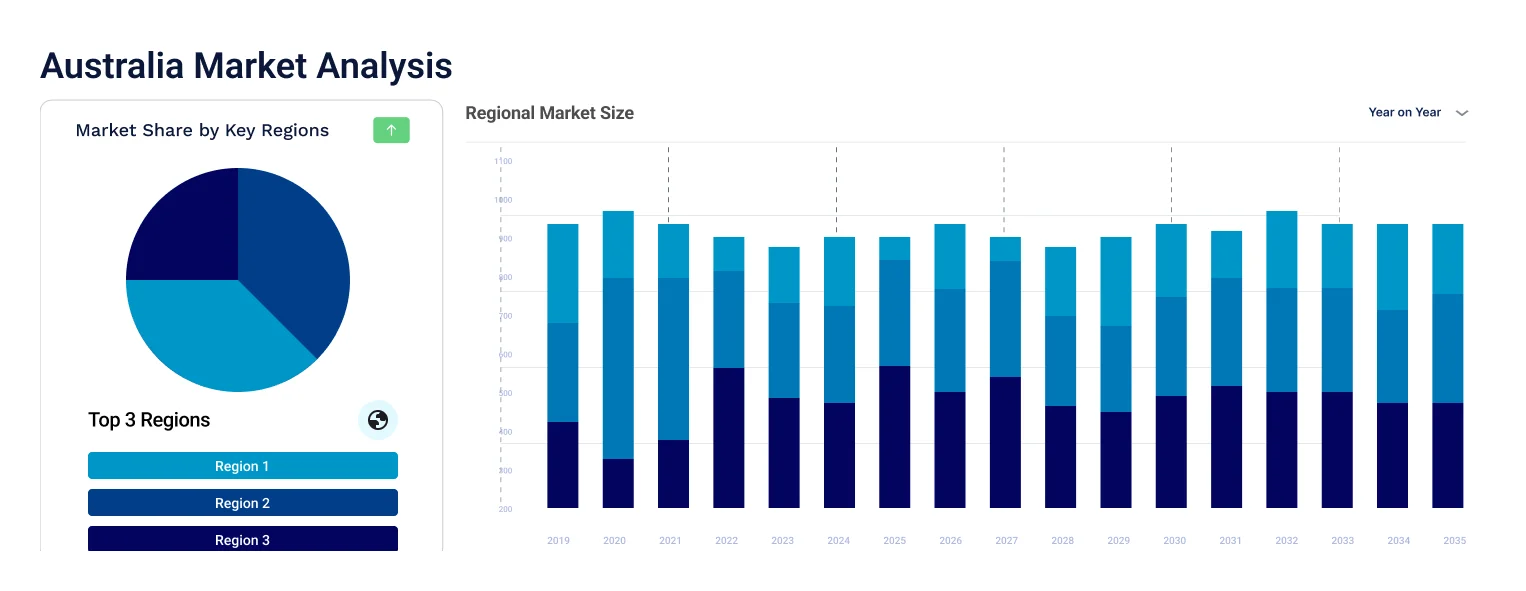
New South Wales dominates, in our estimate, as the most populous state with the deepest private hospital base, and it grows at an estimated 2.1% CAGR through 2035 from a mature base. Victoria grows at 2.2%, with Healthscope's Holmesglen Private moving to Calvary. Queensland is the fastest-growing region at an estimated 3.1%, as Gold Coast Private Hospital transfers to Mater Health. Western Australia grows at 2.5%. Others, covering South Australia, Tasmania, the Australian Capital Territory and the Northern Territory, grow at 2.4%, including Ramsay's National Capital Private Hospital in Canberra.
| CAGR 2026 to 2035, Market by Region | Growth Rate |
| New South Wales | 2.1 % |
| Victoria | 2.2 % |
| Queensland | 3.1 % |
| Western Australia | 2.5 % |
| Others (incl. South Australia, Tasmania, the Australian Capital Territory and the Northern Territory) | 2.4 % |
Competition combines private hospital groups that host most operations, global device makers supplying staplers, robots and balloons, and surgeon-led practices. Entry barriers include theatre access, surgeon accreditation, registry participation, regulatory approval of devices and relationships with insurers.
Ramsay Health Care
Ramsay Health Care, headquartered in Sydney, operates private hospitals across Australia and lists bariatric surgery among its services, including at its national capital sites. Healthscope's media release of 6 February 2026 said agreements had been reached for Ramsay to acquire National Capital Private Hospital in Canberra. The addition extends its elective surgery footprint into a region with limited private capacity, where weight-loss operations form part of surgical lists.
Johnson & Johnson MedTech
Johnson & Johnson MedTech, based in New Brunswick, New Jersey, supplies Ethicon staplers, including the Echelon range listed on its Australian site. In June 2025 it launched the ETHICON 4000 stapler in the United States and showed it to bariatric surgeons at the ASMBS annual meeting. In April 2026 the device received a European CE Mark, and robotic integration with its OTTAVA system remains in development.
Medtronic
Medtronic, headquartered in Dublin, Ireland, supplies surgical stapling, energy devices and the Hugo robotic-assisted surgery system, which its Australian site lists for urologic, gynaecologic and general laparoscopic procedures. Medtronic received FDA clearance for Hugo in December 2025 and completed the first United States case in February 2026, with general surgery expansion planned. Hospital robotic investment may raise demand for compatible bariatric instruments in Australia.
Allurion
Allurion Technologies, based in Natick, Massachusetts, makes the Allurion Gastric Balloon, a swallowable capsule filled with fluid for about four months. The Australian Register of Therapeutic Goods lists the device as an active Class IIb gastric balloon for appetite suppression, sponsored by Emergo Australia. Allurion announced an FDA decision on 23 February 2026, supported by the AUDACITY trial of 550 participants, giving clinics a non-surgical entry option.
Other players operating in the Australia bariatric surgery market include Healthscope, Calvary Health Care, St Vincent's Health Australia, Mater Health, and Epworth HealthCare, alongside independent bariatric surgeons, day hospital operators, specialist clinics and smaller device distributors serving surgeons, hospitals and patients across Australia.
Competition rests on theatre access, surgeon accreditation, device approvals and insurer relationships rather than price alone, while ownership changes among hospital groups could reshape positions across the forecast period.


Upto 15% Off
AUD
$2749 $2499
$3849 $3499
$4949 $4499
$6049 $5499


*While we strive to always give you current and accurate information, the numbers depicted on the website are indicative and may differ from the actual numbers in the main report. At Expert Market Research, we aim to bring you the latest insights and trends in the market. Using our analyses and forecasts, stakeholders can understand the market dynamics, navigate challenges, and capitalize on opportunities to make data-driven strategic decisions.*
The Australia bariatric surgery market is valued at AUD 295.00 million in 2025, supported by a rising obesity burden, steady private hospital capacity, gradual adoption of robotic platforms and a mix of bypass and revision operations, with New South Wales as the largest region.
The market is forecast to reach AUD 373.96 million by 2035, growing at a CAGR of 2.40 % over the 2026 to 2035 period, driven by severe obesity, narrow public subsidy of weight-loss medicines, private hospital ownership change and new stapling, robotic and balloon technology.
One-Anastomosis Gastric Bypass records the highest CAGR at an estimated 4.1% through 2035, as surgeons adopt the shorter operation for durable weight loss and diabetes control.
New South Wales dominates, as the most populous state with the deepest private hospital base. Queensland is the fastest-growing region at an estimated 3.1% CAGR, helped by population growth and new private capacity.
Key players include Ramsay Health Care, Johnson & Johnson MedTech, Medtronic, Allurion, Healthscope, Calvary Health Care, St Vincent's Health Australia, Mater Health, and Epworth HealthCare.
The Bariatric Surgery Registry is a national outcomes registry hosted by Monash University. In June 2026 it said it had secured two further years of Australian Government funding and would release its 2025 annual reports.
Not entirely. The Pharmaceutical Benefits Advisory Committee recommended Wegovy in November 2025 for patients with cardiovascular disease and a BMI of 35 or more, with managed access, so most patients remain outside subsidy.
Explore our key highlights of the report and gain a concise overview of key findings, trends, and actionable insights that will empower your strategic decisions.
| REPORT FEATURES | DETAILS |
| Base Year | 2025 |
| Historical Period | 2019-2025 |
| Forecast Period | 2026-2035 |
| Scope of the Report |
Historical and Forecast Trends, Industry Drivers and Constraints, Historical and Forecast Market Analysis by Segment:
|
| Breakup by Procedure Type |
|
| Breakup by Surgical Approach |
|
| Breakup by Region |
|
| Market Dynamics |
|
| Competitive Landscape |
|
| Companies Covered |
|
Datasheet
AUD 2,749
AUD 2,499
tax inclusive*
Single User License
AUD 3,849
AUD 3,499
tax inclusive*
Five User License
AUD 4,949
AUD 4,499
tax inclusive*
Corporate License
AUD 6,049
AUD 5,499
tax inclusive*
*Please note that the prices mentioned below are starting prices for each bundle type. Kindly contact our team for further details.*
Flash Bundle
Small Business Bundle
Growth Bundle
Enterprise Bundle
*Please note that the prices mentioned below are starting prices for each bundle type. Kindly contact our team for further details.*
Flash Bundle
Number of Reports: 3
20%
tax inclusive*
Small Business Bundle
Number of Reports: 5
25%
tax inclusive*
Growth Bundle
Number of Reports: 8
30%
tax inclusive*
Enterprise Bundle
Number of Reports: 10
35%
tax inclusive*
How To Order

Select License Type
Choose the right license for your needs and access rights.

Click on ‘Buy Now’
Add the report to your cart with one click and proceed to register.

Select Mode of Payment
Choose a payment option for a secure checkout. You will be redirected accordingly.
Strategic Solutions for Informed Decision-Making
Stay upgraded and grab opportunities by strategic insights
Stay informed and aware for a Market Leverage
Analyze pricing patterns with comprehensive trend analyses.
Analyse trade data for supply chain insights.

Leverage cost reports for smart savings
Elevate supply chain with collaboration
Contact Us for Further Information
Our specialized analysts will be available to answer all the pre-purchase and post-purchase queries regarding the report.
Our specialized analysts will be available to answer all the pre-purchase and post-purchase queries regarding the report.
Staying one step ahead of the market landscape with our in-depth research methods, integrating advanced analytics to drive precise and tangible outcomes.
Our expert analyst team offers a significant advantage over competitors, with extensive market insights into the latest trends, putting you strategically ahead.
We deliver a simplified yet extensive report, comprising in-depth industry insights and analytics tailored to your industry requirements.
We are happy to help you navigate through the services we offer and solve your queries.
Contact us