Consumer Insights
Uncover trends and behaviors shaping consumer choices today
Procurement Insights
Optimize your sourcing strategy with key market data
Industry Stats
Stay ahead with the latest trends and market analysis.
The Australia continuous glucose monitoring market covers wearable sensors, transmitters, readers and software that measure interstitial glucose every minute or few minutes and send readings to a smartphone, reader or insulin pump. Systems replace most finger-prick tests and feed automated insulin delivery, and the Australian Government subsidises them for people with type 1 diabetes through the National Diabetes Services Scheme.
In 2025, the market is valued at AUD 450.00 million and is forecast to grow at a CAGR of 8.50%, reaching AUD 1017.44 million by 2035. Growth is driven by the subsidy program, about 2 million Australians living with diagnosed and undiagnosed diabetes, and the pairing of sensors with automated insulin pumps.
Compound Annual Growth Rate
8.5%
Value in AUD million
2026-2035
The Australia continuous glucose monitoring market is shifting from a niche device for insulin-treated children to standard care. Finger-prick meters once dominated monitoring, but subsidised sensors, smartphone apps and pump integration now make continuous data the default for type 1 diabetes.
Three forces shape demand: the Australian Government subsidy, committed at AUD 682.3 million over four years; frequent product turnover as 15-day sensors replace older models; and pressure from the diabetes sector to extend funding to type 2 diabetes.
In December 2025 FreeStyle Libre 3 Plus joined the subsidy for mylife Loop users, in July 2026 FreeStyle Libre 2 left it, and from October 2026 Libre 3 Plus is available as a standalone sensor.
The market is moving from a type 1 subsidy product towards a connected care platform in which sensors, apps and insulin pumps are bought and updated together. Sensors lead because every user needs a steady supply, while software and mobile apps advance fastest as phones replace dedicated readers. Fifteen-day sensors gain share quickest, and type 2 diabetes grows fastest if subsidy is extended and private purchase widens. New South Wales remains the largest state, while Western Australia grows fastest. Subsidy rules, pump integration and competition between global suppliers point to a durable, multi-year demand outlook rather than a cyclical uplift.
| Metric | Value |
| Market Size 2025 | AUD 450.00 million |
| Projected Market Size 2035 | AUD 1017.44 million |
| CAGR 2026 to 2035 | 8.50% |
| Fastest-Growing Component | Software and Mobile Apps: 11.0% CAGR |
| Fastest-Growing Sensor Wear Duration | 15 Days: 10.2% CAGR |
| Largest Revenue Segment 2025 | Sensors |
| Dominant State | New South Wales |
| Highest CAGR by State | Western Australia: 9.4% |
| Government funding committed for subsidised CGM | AUD 682.3 million over 4 years |
Subsidy Design Sustains Sensor Demand
Revenue is on course to rise by about 126% across the decade, from AUD 450.00 million in 2025 to AUD 1,017.44 million in 2035 at an 8.5% CAGR. Sensors are replaced every 7 to 15 days, so each subsidised registrant generates recurring demand, while the AUD 682.3 million commitment underwrites it.
Apps, Longer Wear and Type 2 Access Lead Growth
Sensors hold the largest revenue share, but software and mobile apps grow at an estimated 11.0% CAGR, 15-day sensors at 10.2% and type 2 diabetes at 12.0% through 2035. A Medical Services Advisory Committee consultation on type 2 funding closed on 12 June 2026, keeping the expansion case open.
FreeStyle Libre 3 Plus Becomes a Standalone Subsidised Sensor
Abbott's FreeStyle Libre 3 Plus moved from mylife Loop use only to standalone subsidy on 1 October 2026, widening choice for all Australians with type 1 diabetes. It needs the new Libre app, which is still coming to Australia.
| Report Summary | Unit | Value |
| Base Year | AUD million | 2025 |
| Historical Period | AUD million | 2019 to 2025 |
| Forecast Period | AUD million | 2026 to 2035 |
| Market Size 2025 | AUD million | 450.00 |
| Market Size 2035 | AUD million | 1017.44 |
| CAGR 2026 to 2035 | Percentage | 8.50 % |
| CAGR by Component: Software and Mobile Apps | Percentage | 11.0 % |
| CAGR by Sensor Wear Duration: 15 Days | Percentage | 10.2 % |
| CAGR by Diabetes Type: Type 2 Diabetes | Percentage | 12.0 % |
| CAGR by State: Western Australia | Percentage | 9.4 % |
| Australians Living With Diagnosed and Undiagnosed Diabetes | Million Persons | 2 |
| Australian Population March 2026 | Million Persons | 27.92 |
| Market Share by State 2025 | New South Wales | Dominant Share |
Subsidised access, frequent sensor replacement and pump integration make this a structural category. Sensors lead, while software, longer-wear sensors and type 2 diabetes grow fastest across the forecast period.
The Australia continuous glucose monitoring market is being shaped by subsidy product changes, unresolved type 2 funding, sector budget requests and the shift to longer-wear sensors.
October 2026 - FreeStyle Libre 3 Plus Becomes Available as a Standalone NDSS Sensor
July 2026 - FreeStyle Libre 2 Sensor Delisted From the NDSS
May 2026 - Government Notes Recommendation to Widen CGM Access
February 2026 - Diabetes Sector Seeks Type 2 CGM Funding in Budget Submission
Policy still defines the market. Listings change quickly and wider type 2 funding remains open, so suppliers plan for both subsidised growth and a stronger private-pay segment.
Recent developments, presented from the most recent, show the Australia continuous glucose monitoring market moving from supplier results and listings into product launches and ownership change.
September 2026 - Medtronic Ends Standalone Guardian System (4) Transmitter Support
August 2026 - Melbourne Hosts Diabetes Congress as SIBIONICS Shows GS3
July 2026 - Dexcom and Abbott Report Rising Sensor Sales
March 2026 - MiniMed Lists on Nasdaq After Medtronic Separation
Recent activity shows suppliers reshaping portfolios around pumps and longer-wear sensors. Listings, delistings and corporate separation matter more locally than any single launch across the forecast period.
The Expert Market Research’s report on the Australia Continuous Glucose Monitoring Market offers a detailed analysis of the market based on the following segments.
Market Breakup by Component
Sensors lead because each user consumes a steady stream of disposable units, and Dexcom G7 sensors were subsidised from 1 March 2025 at an AUD 11.60 co-payment. Software and Mobile Apps grows fastest at an estimated 11.0% CAGR through 2035, as the Libre 3 Plus relies on a new app that is coming soon to Australia. Transmitters decline in relevance as the Guardian System (4) transmitter lost standalone support on 1 September 2026. Receivers and Readers remain relevant, since NDSS registrants can obtain a FreeStyle Libre 2 Reader free of charge. Others include adhesive patches, applicators and warranty replacements.
Market Breakup by Sensor Wear Duration
Ten Days leads on an estimated basis, as Dexcom G7 gained NDSS subsidy in March 2025 and remains compatible with Tandem, Omnipod 5 and mylife Ypsopump systems. Fifteen Days grows fastest at an estimated 10.2% CAGR through 2035, since FreeStyle Libre 2 Plus joined the NDSS in April 2025 and automatically replaced the Libre 2 in July 2026. Up to 7 Days covers the Medtronic Guardian sensor, now confined to the MiniMed 780G. Others include 14-day sensors, such as the SIBIONICS GS3 shown in Melbourne in August 2026, and professional sensors worn for clinical studies.
Market Breakup by Diabetes Type
Type 1 Diabetes leads because every person with the condition can apply for subsidy, and Breakthrough T1D reports that over 70% already use a sensor. Type 2 Diabetes grows fastest at an estimated 12.0% CAGR through 2035, as the Medical Services Advisory Committee consultation on application 1786 closed in June 2026 and the sector seeks AUD 106.48 million for 16,000 people. Gestational Diabetes and Other Insulin-Requiring Diabetes sit within the same funding case, and the committee has called these populations small but high need. Others include prediabetes, wellness users and research cohorts.
Market Breakup by Region
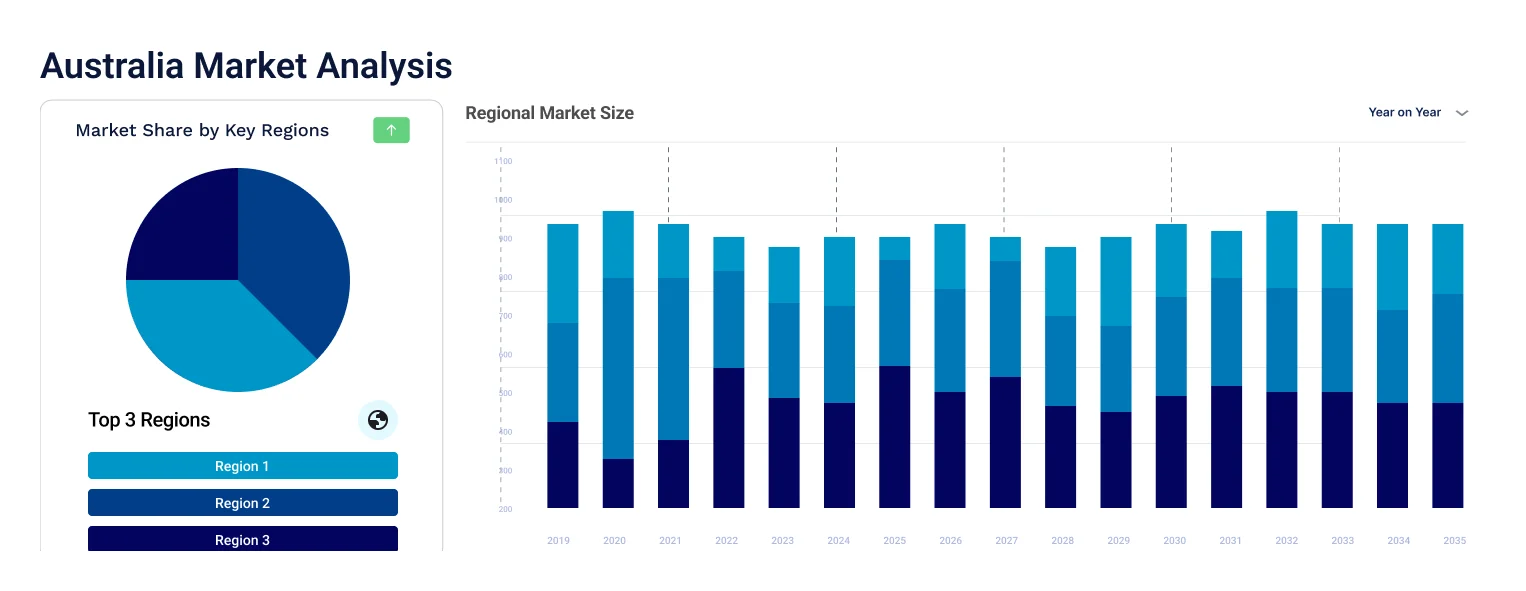
New South Wales dominates with 8.67 million residents in March 2026, and it grows at an estimated 8.1% CAGR through 2035. Western Australia is fastest at an estimated 9.4%, as its population grew 2.1% in the year to March 2026 and Diabetes WA opened Libre 3 Plus clinic support from 1 October 2026. Victoria, at an estimated 8.7%, hosted the diabetes congress in August 2026 with 7.15 million residents. Queensland grows at 8.9% on 5.74 million residents, and South Australia at 7.8% on 1.92 million. Others covers Tasmania, the ACT and the Northern Territory, growing at an estimated 8.0%.
| CAGR 2026 to 2035, Market by State | Growth Rate |
| New South Wales | 8.1 % |
| Victoria | 8.7 % |
| Queensland | 8.9 % |
| Western Australia | 9.4 % |
| South Australia | 7.8 % |
| Others (incl. Tasmania, ACT and Northern Territory) | 8.0 % |
Competition combines global sensor makers, pump partners and a few new entrants. Barriers include TGA inclusion, NDSS listing, pump and app compatibility, clinician training through credentialled educators, and the supply logistics that keep subsidised sensors available through community pharmacies.
Dexcom
Dexcom, founded in 1999 and based in San Diego, makes the G7 sensor, which has been subsidised on the NDSS since 1 March 2025 and works with Tandem, Omnipod 5 and mylife Ypsopump systems. Its Australian arm, AMSL Diabetes, supplies local customers. In July 2026 Dexcom reported second-quarter revenue of USD 1.31 billion, with international sales up 19%, and said Health Canada had cleared its 15-day G7 sensor.
Abbott
Abbott Diabetes Care, part of Abbott, makes FreeStyle Libre sensors and is the only supplier with two 15-day sensors on the NDSS. Libre 2 Plus joined on 1 April 2025, Libre 3 Plus on 1 December 2025 for mylife Loop users, and Libre 2 was delisted on 1 July 2026. Standalone Libre 3 Plus access began on 1 October 2026, and Abbott reported Diabetes Care sales of USD 2.19 billion in July 2026.
Medtronic
Medtronic Australasia sponsors the Simplera sensor on the Australian register, with Therapeutic Goods Administration advertising approvals dated February and May 2025. Its diabetes unit began trading as MiniMed on Nasdaq on 6 March 2026, raising USD 560 million gross. The NDSS ended standalone Guardian System (4) transmitter support on 1 September 2026, leaving the sensor tied to the MiniMed 780G pump.
Insulet
Insulet makes the tubeless Omnipod 5 system, launched commercially in Australia on 18 March 2025 with Dexcom G6 and G7 compatibility. Its Australian pods now pair with FreeStyle Libre 2 Plus as well as Dexcom G6, and the October 2026 NDSS chart lists Omnipod 5 as compatible with G7, Libre 2 Plus and Libre 3 Plus. Insulet is not a sensor maker, but it shapes which sensors subsidised pump users choose.
Other players operating in the Australia continuous glucose monitoring market include Ypsomed Australia, Tandem Diabetes Care, Roche Diabetes Care Australia, Revelare DX, and SIBIONICS, alongside pharmacies serving as NDSS access points, diabetes educators and app developers supporting sensor distribution and training across Australia.
Competition rests on subsidy listing, pump compatibility, wear time and app quality rather than price alone. Global sensor makers anchor supply, while pump partners and entrants shape patient choice.


Upto 15% Off
AUD
$2749 $2499
$3849 $3499
$4949 $4499
$6049 $5499


*While we strive to always give you current and accurate information, the numbers depicted on the website are indicative and may differ from the actual numbers in the main report. At Expert Market Research, we aim to bring you the latest insights and trends in the market. Using our analyses and forecasts, stakeholders can understand the market dynamics, navigate challenges, and capitalize on opportunities to make data-driven strategic decisions.*
The Australia continuous glucose monitoring market is valued at AUD 450.00 million in 2025, supported by the NDSS subsidy, longer-wear sensors and pump integration, with New South Wales as the largest state.
The market is forecast to reach AUD 1017.44 million by 2035, growing at a CAGR of 8.50 % over the 2026 to 2035 period, driven by subsidised sensor replacement, automated insulin delivery pairing and sector calls for type 2 diabetes access.
Type 2 Diabetes records the highest CAGR at an estimated 12.0% through 2035, as sector submissions seek subsidy for 16,000 people and private purchase of sensors widens beyond type 1 diabetes.
New South Wales dominates, supported by 8.67 million residents in March 2026. Western Australia is the fastest-growing state at an estimated 9.4% CAGR, helped by population growth of 2.1% in the year to March 2026.
Key players include Dexcom, Abbott, Medtronic, Insulet, Ypsomed Australia, Tandem Diabetes Care, Roche Diabetes Care Australia, Revelare DX, and SIBIONICS.
All people with type 1 diabetes can apply through the National Diabetes Services Scheme, including adults, children and women planning pregnancy. An endocrinologist, credentialled diabetes educator or specialist physician must certify the form; GPs cannot.
FreeStyle Libre 2 was delisted on 1 July 2026 and users moved to the 15-day Libre 2 Plus. From 1 October 2026 Libre 3 Plus became available as a standalone subsidised sensor.
Explore our key highlights of the report and gain a concise overview of key findings, trends, and actionable insights that will empower your strategic decisions.
| REPORT FEATURES | DETAILS |
| Base Year | 2025 |
| Historical Period | 2019-2025 |
| Forecast Period | 2026-2035 |
| Scope of the Report |
Historical and Forecast Trends, Industry Drivers and Constraints, Historical and Forecast Market Analysis by Segment:
|
| Breakup by Component |
|
| Breakup by Sensor Wear Duration |
|
| Breakup by Diabetes Type |
|
| Breakup by Region |
|
| Market Dynamics |
|
| Competitive Landscape |
|
| Companies Covered |
|
Datasheet
AUD 2,749
AUD 2,499
tax inclusive*
Single User License
AUD 3,849
AUD 3,499
tax inclusive*
Five User License
AUD 4,949
AUD 4,499
tax inclusive*
Corporate License
AUD 6,049
AUD 5,499
tax inclusive*
*Please note that the prices mentioned below are starting prices for each bundle type. Kindly contact our team for further details.*
Flash Bundle
Small Business Bundle
Growth Bundle
Enterprise Bundle
*Please note that the prices mentioned below are starting prices for each bundle type. Kindly contact our team for further details.*
Flash Bundle
Number of Reports: 3
20%
tax inclusive*
Small Business Bundle
Number of Reports: 5
25%
tax inclusive*
Growth Bundle
Number of Reports: 8
30%
tax inclusive*
Enterprise Bundle
Number of Reports: 10
35%
tax inclusive*
How To Order

Select License Type
Choose the right license for your needs and access rights.

Click on ‘Buy Now’
Add the report to your cart with one click and proceed to register.

Select Mode of Payment
Choose a payment option for a secure checkout. You will be redirected accordingly.
Strategic Solutions for Informed Decision-Making
Stay upgraded and grab opportunities by strategic insights
Stay informed and aware for a Market Leverage
Analyze pricing patterns with comprehensive trend analyses.
Analyse trade data for supply chain insights.
Leverage cost reports for smart savings
Elevate supply chain with collaboration
Contact Us for Further Information
Our specialized analysts will be available to answer all the pre-purchase and post-purchase queries regarding the report.
Our specialized analysts will be available to answer all the pre-purchase and post-purchase queries regarding the report.
Staying one step ahead of the market landscape with our in-depth research methods, integrating advanced analytics to drive precise and tangible outcomes.
Our expert analyst team offers a significant advantage over competitors, with extensive market insights into the latest trends, putting you strategically ahead.
We deliver a simplified yet extensive report, comprising in-depth industry insights and analytics tailored to your industry requirements.
We are happy to help you navigate through the services we offer and solve your queries.
Contact us