Consumer Insights
Uncover trends and behaviors shaping consumer choices today
Procurement Insights
Optimize your sourcing strategy with key market data
Industry Stats
Stay ahead with the latest trends and market analysis.
The Australia food cans market covers the supply of steel and aluminium food cans, can bodies, ends and easy-open closures to Australian food and nutritional product packers, together with the tinplate, coatings and seaming services that turn flat metal into a shelf-stable pack. Welded three-piece cans, drawn two-piece cans and aluminium formats protect fruit, vegetables, tomatoes, meals, seafood, pet food and powders through heat processing and long storage.
In 2025, the market is valued at AUD 280.00 million and is forecast to grow at a CAGR of 3.80%, reaching AUD 406.57 million by 2035. Demand rests on Australian canneries in Victoria and Queensland, retailer private-label ranges, export orders and a national packaging reform process that continues to treat widely recycled metal as a low-risk material.
Compound Annual Growth Rate
3.8%
Value in AUD million
2026-2035
The Australia food cans market is a mature, replacement-led segment of metal packaging. Volumes follow canned fruit, tomato, vegetable, soup, seafood, pet food and powder output, while a small group of domestic can makers and importers supply cans and ends to a concentrated set of processors.
Three forces shape demand: cost-of-living pressure that keeps shoppers buying shelf-stable pantry lines and retailer own-brand ranges; processor restructuring and balance sheet repair that reward reliable local supply; and packaging policy that favours recyclable, high-recycled-content formats such as steel and aluminium.
In April 2025 Visy launched a locally made aluminium can with 83% recycled content, in December 2025 national packaging targets reported 86% of packaging as reusable, recyclable or compostable, in May 2026 SPC Global raised AUD 100 million, and in September 2026 the federal government ruled out a new national packaging scheme this term.
The market is set to grow modestly as processors protect shelf-stable ranges, retailers push own-brand lines and packers favour formats that recycle widely. Three-piece steel cans remain the largest segment because tomatoes, fruit and vegetables dominate Australian canning, while can ends and closures advance fastest as easy-open formats and added ends capacity win share. Fruit, vegetables and tomatoes lead applications, dairy and nutritional powders grow quickest, and branded processors remain the largest customers while private-label producers gain pace. Victoria stays the largest base because the Goulburn Valley and Melbourne can making sit together, and Queensland grows quickest from its pineapple and juice cannery base. Supply certainty, recycled content and reform timing, rather than volume spikes, shape a steady outlook.
| Metric | Value |
| Market Size 2025 | AUD 280.00 million |
| Projected Market Size 2035 | AUD 406.57 million |
| CAGR 2026 to 2035 | 3.80% |
| Fastest-Growing Can Type | Can Ends and Closures: 4.6% CAGR |
| Fastest-Growing Food Application | Dairy and Nutritional Powders: 5.2% CAGR |
| Largest Revenue Segment 2025 | Three-Piece Steel Cans |
| Dominant Region | Victoria |
| Highest CAGR by Region | Queensland: 4.4% |
| Share of Australian-made food and powder cans made by Visy | Over 90% |
Replacement Demand Sustains Steady Growth
Revenue is set to rise from AUD 280.00 million in 2025 to AUD 406.57 million in 2035 at a 3.8% CAGR, as canneries, private-label ranges and powder packers keep metal packs in steady use.
Ends and Powders Lead Segment Growth
Three-piece steel cans remain the largest segment, but can ends and closures grow at an estimated 4.6% CAGR and dairy and nutritional powders at 5.2% through 2035, helped by easy-open formats and added ends capacity.
Reform Timing Shapes Supplier Choices
National packaging reform stalled in 2026, so buyers rely on voluntary targets and state rules while weighing recyclability, recycled content and supply security.
| Report Summary | Unit | Value |
| Base Year | AUD million | 2025 |
| Historical Period | AUD million | 2019 to 2025 |
| Forecast Period | AUD million | 2026 to 2035 |
| Market Size 2025 | AUD million | 280.00 |
| Market Size 2035 | AUD million | 406.57 |
| CAGR 2026 to 2035 | Percentage | 3.80 % |
| CAGR by Can Type: Can Ends and Closures | Percentage | 4.6 % |
| CAGR by Food Application: Dairy and Nutritional Powders | Percentage | 5.2 % |
| CAGR by Customer Type: Private-Label Producers | Percentage | 4.7 % |
| CAGR by Region: Queensland | Percentage | 4.4 % |
| Annual Food Cans Made by Visy | Million Cans | 400 |
| Packaging Reusable, Recyclable or Compostable | Percentage | 86 |
| Market Share by Region 2025 | Victoria | Dominant Share |
Steady, replacement-led demand from Australian canneries, retailer private-label ranges and nutritional powder packers keeps spending stable, while recyclability policy and cannery restructuring shape supplier choices.
The Australia food cans market is being shaped by stalled national packaging reform, processor balance sheet repair, retailer ranging decisions and tomato and fruit canning consolidation in Victoria.
September 2026 - Government Rules Out New National Packaging Scheme
August 2026 - SPC Global Reports Higher Earnings on Lower Debt
July 2026 - Ardmona Becomes Exclusive Branded Canned Tomato at Woolworths
March 2026 - Environment Ministers Defer Packaging Design Decisions
Governments are debating packaging rules without settled national design standards, while processors rebuild balance sheets and consolidate sites, so buyers favour can suppliers offering supply certainty and recyclable formats.
Recent developments, presented from the most recent, show the Australia food cans market moving from recycled-content can launches and national targets into processor recapitalisation and grower contract resets.
September 2026 - Simplot Tasmanian Growers Sign Contracts at Lower Prices
May 2026 - SPC Global Launches AUD 100 Million Capital Raise
December 2025 - National Packaging Targets Report Recyclability Progress
April 2025 - Visy Launches 83% Recycled Content Aluminium Can
Recent events show processors recapitalising, growers renegotiating contracts and governments delaying a national packaging scheme, leaving can demand steady but exposed to retailer pricing and rule changes.
The Expert Market Research’s report on the Australia Food Cans Market offers a detailed analysis of the market based on the following segments.
Market Breakup by Can Type
Three-Piece Steel Cans lead because tomatoes, fruit, vegetables and soups are packed in welded tinplate bodies, and Visy's food cans page in October 2026 cites over 400 million food cans a year. Can Ends and Closures grow fastest at an estimated 4.6% CAGR, as the Coburg upgrade adds capacity for 100 million extra ends and easy-open ring-pull ends gain share. Two-Piece Steel Cans serve seafood and pet food in smaller volumes. Aluminium Food Cans are the smallest group, though Visy's April 2025 recycled-content aluminium can shows local lines can handle high recycled input.
Market Breakup by Food Application
Fruit, Vegetables and Tomatoes lead because Shepparton hosts Australia's largest fruit processor and tinned tomato processing, and SPC Global reported tomato sales up 3.5% in July 2026. Dairy and Nutritional Powders grow fastest at an estimated 5.2% CAGR, since Visy lists infant formula and powdered beverage cans among its products in October 2026. Soups, Meals and Baked Beans follow steadily, with baked beans and spaghetti sales up 4% in the June 2026 quarter. Meat, Fish and Pet Food rely largely on imported filled cans and domestic pet food lines, so growth is the slowest.
Market Breakup by Customer Type
Branded Food Processors lead because SPC Global, Golden Circle and similar owners buy the bulk of local cans for established shelf-stable brands. Private-Label Producers grow fastest at an estimated 4.7% CAGR, as Woolworths made Ardmona its exclusive branded canned tomato range in July 2026 and retailers continue to expand own-brand lines. Nutritional and Dairy Powder Packers expand steadily with Visy's powder can range. Export-Oriented Processors grow slowest, since SPC Global's international sales eased to AUD 45.9 million in the year to June 2026, though margins improved sharply.
Market Breakup by Region
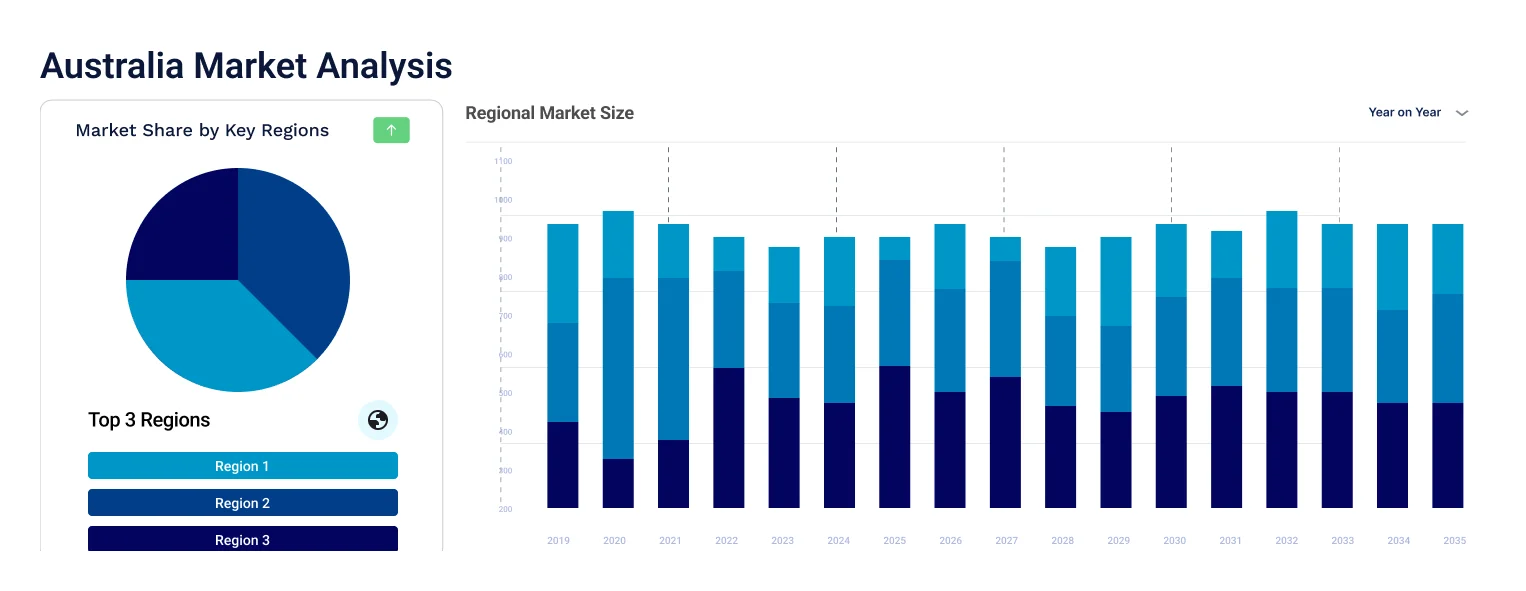
Victoria dominates, as the Committee for Greater Shepparton said in May 2026 that its region holds Australia's largest fruit processor and only tinned tomato processors, and Visy's Coburg plant sits in Melbourne; it grows at an estimated 3.4% from a large base. Queensland is fastest at an estimated 4.4%, led by the Golden Circle cannery at Northgate. Tasmania grows at 4.1%, as Simplot's growers signed new contracts in September 2026. New South Wales grows at 3.9% as a buyer and Riverina supplier. Others, grouping South Australia, Western Australia, the ACT and the Northern Territory, grows at 3.6%.
| CAGR 2026 to 2035, Market by Region | Growth Rate |
| Victoria | 3.4 % |
| Queensland | 4.4 % |
| New South Wales | 3.9 % |
| Tasmania | 4.1 % |
| Others (incl. South Australia, Western Australia, the Australian Capital Territory and the Northern Territory) | 3.6 % |
Competition combines a dominant domestic can maker, importers of empty cans and ends, and large food processors that set specifications and negotiate on price. Entry barriers include tinplate sourcing, seaming and coating know-how, food safety approvals and the capital needed for can lines.
Visy
Visy is a privately owned packaging and recycling group headquartered in Melbourne that makes steel food cans and ends at Coburg in Victoria. Its food cans page, viewed in October 2026, claims over 90% of Australian-made food and nutritional powder cans, over 400 million cans a year and a Coburg upgrade adding capacity for 100 million ends. In April 2025 it launched an aluminium can with 83% recycled content at Yatala, Queensland.
SPC Global
SPC Global is headquartered in Shepparton, Victoria, and is listed on the ASX. It cans fruit, tomatoes, baked beans and spaghetti under the SPC and Ardmona brands, and also owns Nature One and The Original Beverage Co. In May 2026 it raised AUD 100 million to cut debt, in July 2026 Ardmona became Woolworths' exclusive branded canned tomato range, and in August 2026 it reported normalised EBITDA of AUD 38.5 million.
Kraft Heinz Australia (Golden Circle)
Kraft Heinz Australia operates the Golden Circle brand, whose cannery at Northgate in Brisbane produces over 150,000 tonnes a year of canned pineapple, juices and cordials according to the brand's website, viewed in October 2026. Kraft Heinz, its owner, is headquartered in Chicago and Pittsburgh. As an anchor food can buyer in Queensland, the cannery ties Queensland demand to pineapple fruit supply and brand ranging decisions.
Simplot Australia
Simplot Australia is the local arm of J.R. Simplot of Boise, Idaho, and processes vegetables, potatoes and prepared foods under brands including Edgell, Leggo's and Birds Eye. In September 2026, most Tasmanian growers supplying Simplot signed new contracts with an average price cut of 2.5%. Its canned and processed vegetable ranges depend on steady supplies of cans and closures from domestic makers and importers.
Other players operating in the Australia food cans market include Kagome Australia, Riviana Foods, John West Australia, Campbell Soup Australia, and Safcol Australia, alongside tinplate importers, closure suppliers, private-label packers and co-packers supporting food processors across Australia.
Competition is concentrated: one domestic can maker dominates local supply, so processors weigh import options, lightweighting and recycled content, and compete mainly on service reliability, price and sustainability credentials.


Upto 15% Off
AUD
$2749 $2499
$3849 $3499
$4949 $4499
$6049 $5499


*While we strive to always give you current and accurate information, the numbers depicted on the website are indicative and may differ from the actual numbers in the main report. At Expert Market Research, we aim to bring you the latest insights and trends in the market. Using our analyses and forecasts, stakeholders can understand the market dynamics, navigate challenges, and capitalize on opportunities to make data-driven strategic decisions.*
The Australia food cans market is valued at AUD 280.00 million in 2025, supported by replacement demand from canneries, retailer private-label ranges and recyclable metal packaging, with Victoria as the largest base.
The market is forecast to reach AUD 406.57 million by 2035, growing at a CAGR of 3.80 % over the 2026 to 2035 period, driven by growth in can ends and closures, dairy and nutritional powders, private-label ranges and Queensland cannery demand.
Can Ends and Closures record the highest CAGR at an estimated 4.6% through 2035, as easy-open formats gain share and Visy's Coburg upgrade adds capacity for 100 million extra ends.
Victoria dominates, supported by Shepparton fruit and tomato canning and Visy's Coburg can plant. Queensland is the fastest-growing region at an estimated 4.4% CAGR, helped by the Golden Circle cannery.
Key players include Visy, SPC Global, Kraft Heinz Australia (Golden Circle), Simplot Australia, Kagome Australia, Riviana Foods, John West Australia, Campbell Soup Australia, and Safcol Australia.
It is a food can built from a welded tinplate body plus a separate top and bottom end. It suits tomatoes, fruit and vegetables, and Visy reports making over 400 million food cans a year.
In September 2026 the federal government ruled out a new national packaging scheme this term, so voluntary targets and state rules continue. Buyers still weigh recyclability and recycled content when choosing steel or aluminium cans.
Explore our key highlights of the report and gain a concise overview of key findings, trends, and actionable insights that will empower your strategic decisions.
| REPORT FEATURES | DETAILS |
| Base Year | 2025 |
| Historical Period | 2019-2025 |
| Forecast Period | 2026-2035 |
| Scope of the Report |
Historical and Forecast Trends, Industry Drivers and Constraints, Historical and Forecast Market Analysis by Segment:
|
| Breakup by Can Type |
|
| Breakup by Food Application |
|
| Breakup by Customer Type |
|
| Breakup by Region |
|
| Market Dynamics |
|
| Competitive Landscape |
|
| Companies Covered |
|
Datasheet
AUD 2,749
AUD 2,499
tax inclusive*
Single User License
AUD 3,849
AUD 3,499
tax inclusive*
Five User License
AUD 4,949
AUD 4,499
tax inclusive*
Corporate License
AUD 6,049
AUD 5,499
tax inclusive*
*Please note that the prices mentioned below are starting prices for each bundle type. Kindly contact our team for further details.*
Flash Bundle
Small Business Bundle
Growth Bundle
Enterprise Bundle
*Please note that the prices mentioned below are starting prices for each bundle type. Kindly contact our team for further details.*
Flash Bundle
Number of Reports: 3
20%
tax inclusive*
Small Business Bundle
Number of Reports: 5
25%
tax inclusive*
Growth Bundle
Number of Reports: 8
30%
tax inclusive*
Enterprise Bundle
Number of Reports: 10
35%
tax inclusive*
How To Order

Select License Type
Choose the right license for your needs and access rights.

Click on ‘Buy Now’
Add the report to your cart with one click and proceed to register.

Select Mode of Payment
Choose a payment option for a secure checkout. You will be redirected accordingly.
Strategic Solutions for Informed Decision-Making
Stay upgraded and grab opportunities by strategic insights
Stay informed and aware for a Market Leverage
Analyze pricing patterns with comprehensive trend analyses.
Analyse trade data for supply chain insights.
Leverage cost reports for smart savings
Elevate supply chain with collaboration
Contact Us for Further Information
Our specialized analysts will be available to answer all the pre-purchase and post-purchase queries regarding the report.
Our specialized analysts will be available to answer all the pre-purchase and post-purchase queries regarding the report.
Staying one step ahead of the market landscape with our in-depth research methods, integrating advanced analytics to drive precise and tangible outcomes.
Our expert analyst team offers a significant advantage over competitors, with extensive market insights into the latest trends, putting you strategically ahead.
We deliver a simplified yet extensive report, comprising in-depth industry insights and analytics tailored to your industry requirements.
We are happy to help you navigate through the services we offer and solve your queries.
Contact us